
Emotional well-being is not about feeling positive all the time. It is about being able to understand what you are feeling, process difficult emotions, and make choices from a place of greater awareness rather than fear.
When life feels uncertain, our minds can become overwhelmed with questions. What if something goes wrong? Am I making the right decision? Why can’t I stop thinking about this? What should I do next?
This is where tarot can become a meaningful tool for reflection.
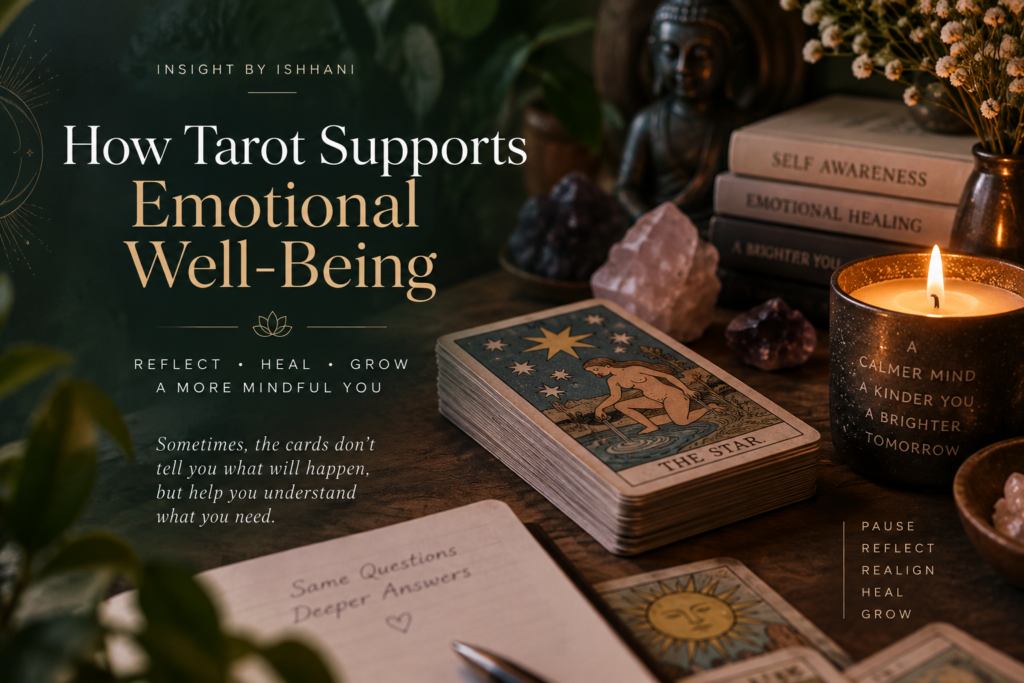
A tarot reading does not have to be about predicting the future. When approached mindfully, tarot supports emotional well-being by creating space to pause, reflect, and look at a situation from a different perspective. Rather than reacting immediately to difficult emotions, tarot encourages you to slow down and explore what may be happening beneath the surface
1. Bringing Hidden Thoughts to the Surface
Many of our thoughts operate automatically. We may worry about something without fully understanding why it affects us so strongly.
During a tarot reading, the imagery and symbolism of the cards can encourage you to explore questions that you may not have considered consciously.
For example:
- What am I really afraid of?
- What belief is influencing this fear?
- What am I avoiding?
- What am I finding difficult to accept?
- What is actually within my control?
These questions can help bring unconscious or overlooked thought patterns into your awareness.
Sometimes, simply recognizing a pattern can change the way you relate to it.
Instead of thinking, “Something is wrong with me because I feel this way,” you may begin to think, “I am feeling this way, and I can explore why.”
That shift can create emotional space.
2. Helping Reduce Overthinking
Overthinking often happens when we try to solve every possible future scenario at once.
The mind keeps moving between what happened, what might happen, and what could go wrong. Eventually, it becomes difficult to distinguish between an actual problem and a feared possibility.
Tarot can gently bring the focus back to the present.
Instead of repeatedly asking:
“What is going to happen?”
You can explore:
- What is happening right now?
- What information do I already have?
- What am I assuming?
- What can I control?
- What small action can I take today?
This change in perspective can be grounding.
A tarot reading may not remove uncertainty, but it can help you develop a more conscious relationship with uncertainty.
3. Increasing Self-Awareness
One of the most valuable aspects of tarot is the opportunity for self-reflection.
When we are emotionally overwhelmed, we often focus entirely on an external outcome.
“Will they come back?”
“Will I get the job?”
“Will this relationship work?”
“Will everything be okay?”
These questions are understandable, but they can sometimes leave us feeling dependent on an answer that is outside our control.
Tarot can redirect the conversation inward.
You might instead ask:
- Why am I so worried about this outcome?
- What does this situation bring up for me?
- What do I need emotionally right now?
- What strength can I rely on?
- What pattern am I repeating?
- What can I learn from this experience?
This kind of tarot healing is less about receiving a fixed prediction and more about developing self-awareness. The cards become a mirror through which you can examine your thoughts, emotions, choices, and beliefs.
4. Helping You Process Emotions
Sometimes anxiety is connected to emotions that have not been fully acknowledged.
You may be carrying grief while telling yourself you have “moved on.”
You may feel anger but believe you are not allowed to express it.
You may experience guilt over something that happened years ago.
You may doubt yourself because of an experience that made you question your worth.
A reflective tarot session can provide a structured space to explore these feelings.
You might discover emotions such as:
- Fear
- Guilt
- Grief
- Anger
- Shame
- Loneliness
- Disappointment
- Self-doubt
- Confusion
Putting a feeling into words can sometimes make it feel more manageable.
Tarot does not need to “fix” an emotion. Sometimes the first step is simply acknowledging that the emotion exists.
Emotional healing often begins with allowing yourself to feel what you have been trying to avoid.
5. Encouraging More Empowered Decisions
When we are anxious, we can sometimes feel as though life is happening to us.
A tarot reading can help shift the focus from helplessness toward choice.
Instead of asking only:
“What will happen to me?”
you can explore:
- What choices are available to me?
- What influences are affecting this situation?
- What are my strengths?
- What obstacles should I be aware of?
- What happens if I continue on my current path?
- What can I do differently?
This approach encourages personal agency.
Tarot cannot guarantee a particular outcome, but it can help you think more consciously about your options.
The goal is not to surrender your decisions to the cards.
The goal is to understand yourself better so that you can make your own decisions with greater clarity.
6. Tarot as a Tool for Reflection, Not Replacement
It is important to understand what tarot can and cannot do.
Tarot can offer symbolism, perspective, reflection, and a structured way to explore your inner world. A thoughtful reading may help you identify patterns and emotions that you have been struggling to articulate.
However, tarot should not replace professional mental-health care.
If anxiety, depression, trauma, panic, or emotional distress is significantly affecting your everyday life, speaking with a qualified mental-health professional is important.
Tarot can exist alongside professional support as a reflective or spiritual practice, rather than being presented as a treatment or cure.
7. How Tarot Reading Helps You Connect With Yourself
At its heart, tarot reading helps create a pause.
In that pause, you can step away from the noise of everyday life and ask yourself questions you may have been avoiding.
You may begin to notice:
What am I feeling?
Why am I feeling this way?
What do I need?
What am I afraid to face?
What is within my control?
What choice feels aligned with who I want to become?
These questions can be surprisingly powerful.
Sometimes clarity does not arrive as a dramatic answer. It comes quietly when you finally give yourself enough space to listen to what you already know.
Final Thoughts
Emotional well-being requires more than simply trying to stay positive. It involves understanding your emotions, recognizing your thought patterns, accepting uncertainty, and learning how to respond to life’s challenges with greater awareness.
Tarot can support this process by giving you a moment to slow down and look inward.
The cards do not have to dictate your future.
They can simply open a conversation with yourself.
And sometimes, that conversation is exactly where clarity begins.
Tarot can be a mirror, a pause, and a pathway toward deeper self-awareness.
Not because the cards have all the answers, but because they can encourage you to ask better questions.